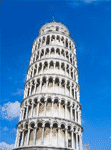
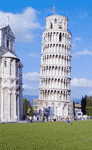
Begun
in 1173, probably under the direction of Bonanno Pisano, the Bell Tower soon
showed problems caused by the sinking of its foundations, so severe as to cause
work on the construction site to be suspended for years. Work was resumed only
in the following century, under the direction of Giovanni di Simone. Of great
interest are the seven bronze bells cast from the 15th to the 18th century,
which sound the tones of the musical scale.
The
Tower of Pisa is often associated with the first experiments with falling
weights alleged to have been conducted by Galileo Galilei between 1590 and 1591, in the presence of
pupils and teachers from the University of Pisa. However, the historical truth
of this fact appears dubious to say the least, despite the fact that a Latin
inscription placed at the entrance recalls that it was from the top of the Bell
Tower that Galileo conducted his famous experiments on falling bodies. "And
then" - wrote his pupil Vincenzo Viviani in the Racconto istorico della vita di Galileo
[Historical Account of Galileo's Life]
(1654) - "to the great consternation of all of the philosophers, they were by
him convinced of the falsity, by means of experiments and with sound
demonstrations and discourse, of very many conclusions of Aristotle himself as
regards the matter of motion, which up to that time had been held as most clear
and indubitable; such as, among other things, that the velocity of falling
bodies of the same material, but different weights, set in motion through the
same means, do not conserve the proportion of their weights, as assigned them
by Aristotle, but on the contrary move at the same speed, demonstrating this
with repeated experiments made from the height of the Bell Tower of Pisa, as
witnessed by other readers and philosophers and by the entire student body."
The
Tower was also the site of a failed experiment of verification conducted by
Carlo Renaldini, a member of the Accademia del Cimento. He tried several times
"at the foot and at the top of the Pisa
Bell Tower", to verify variation in the level of mercury according to the
altitude, but without managing "to attain any results."
